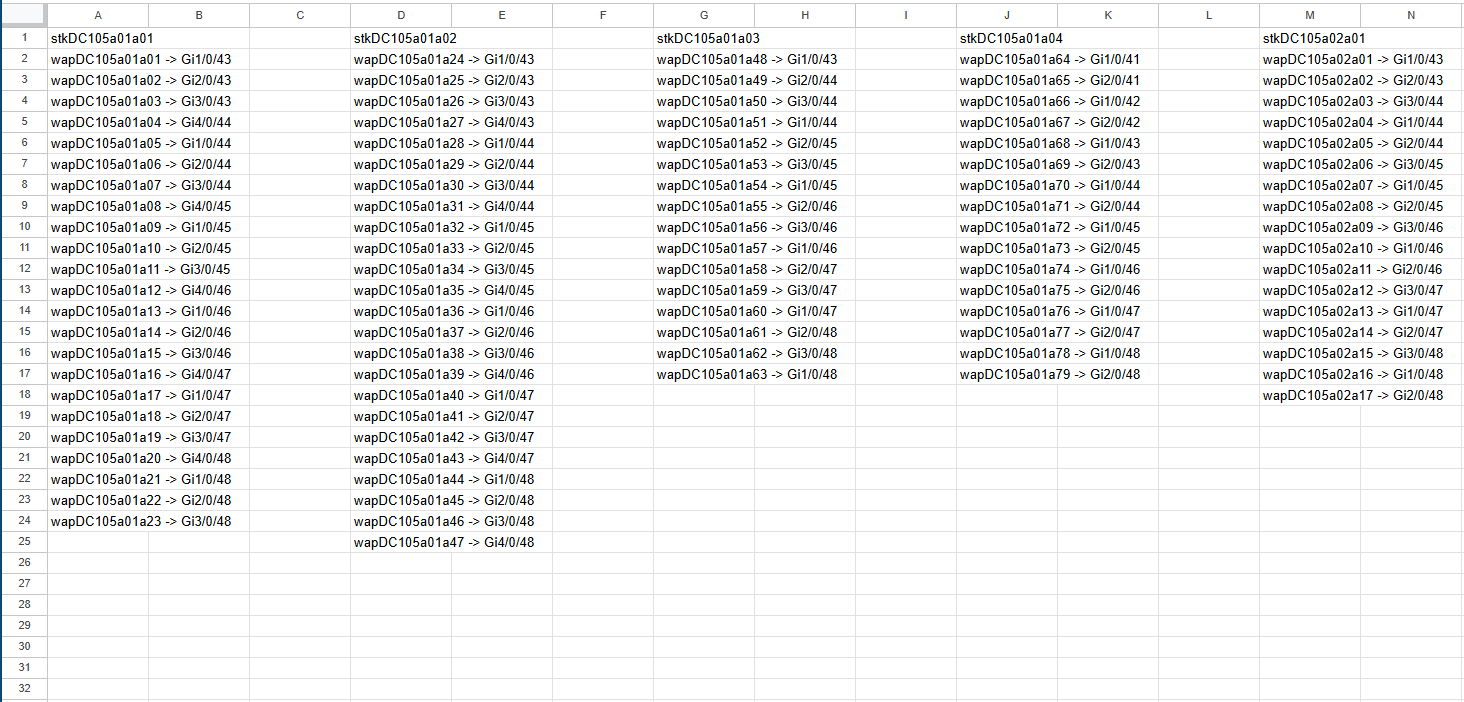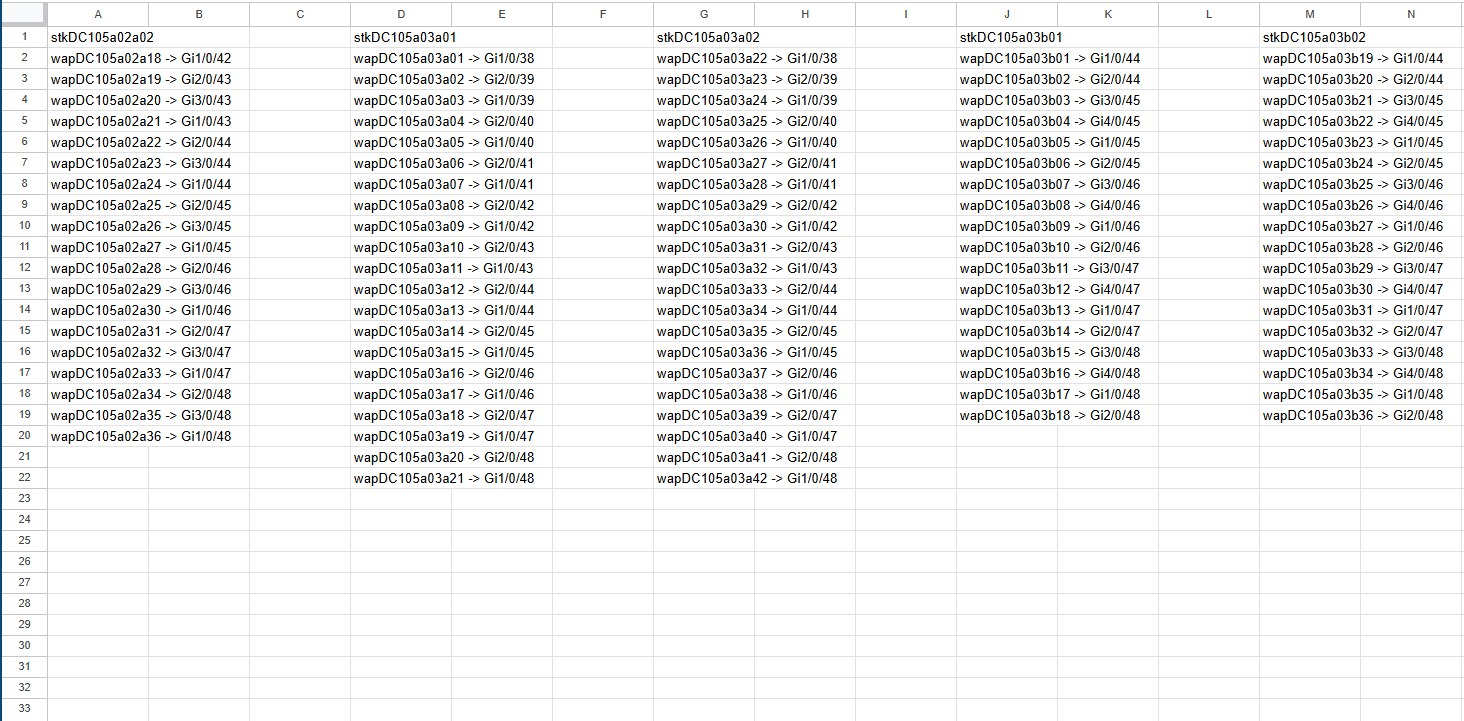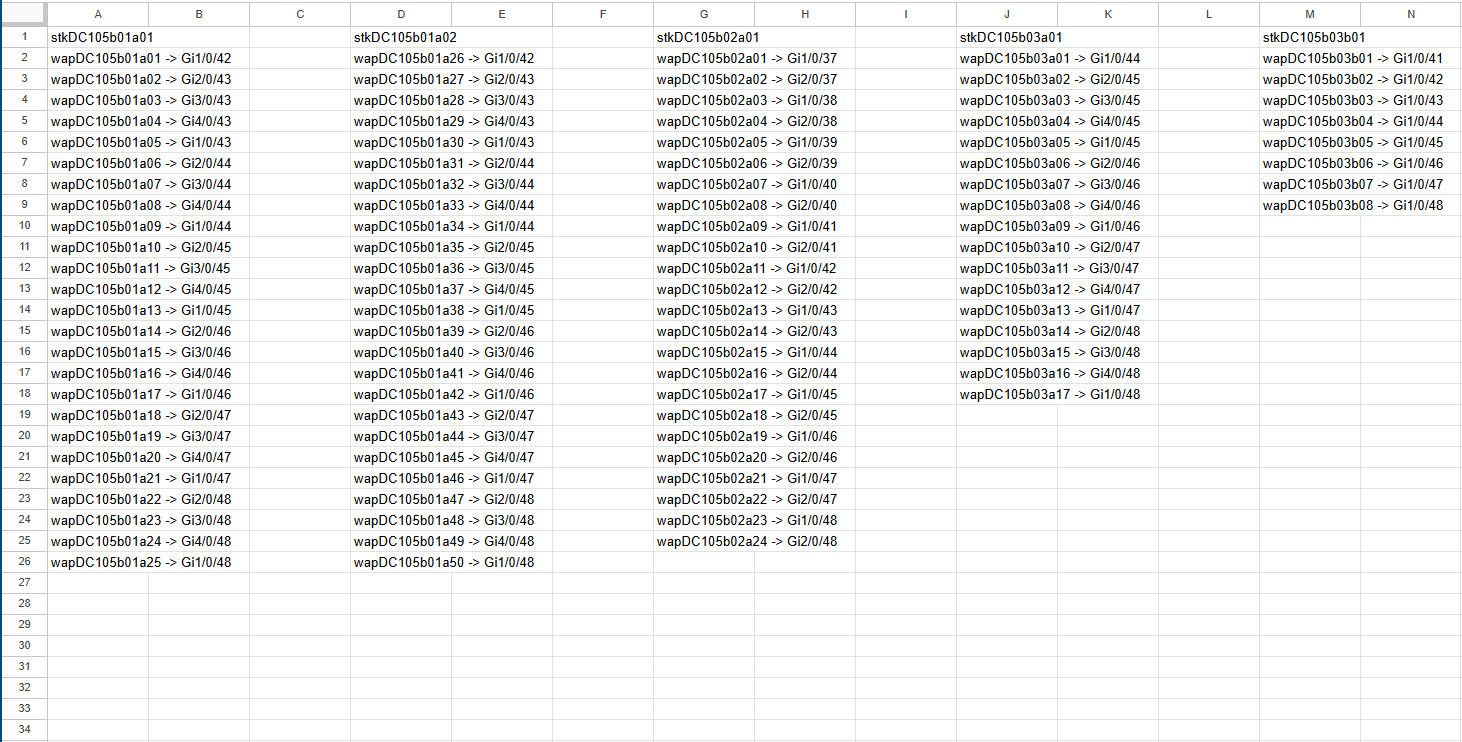
Project Information: The Network Port-Matrix Automation Tool was developed using Python,
to replace a manual network switch-port allocation process. This tool was specifically designed
for wireless access point (WAP) devices that connect to network switches, to provide wireless
connectivity. Standard connection requirements include: WAPs must be connected to the final
ports of each switch, WAPs must be distributed evenly across switch stacks for load-balancing
and redundancy purposes (minimize risk), WAP hostnames must be configured according to
their corresponding switch hostname and MDF/IDF designation. The final output is a port-matrix
consisting of all WAP names paired with the switch-port they will be connected to for each site.
                #Network Port-Matrix Automation Tool - main.py
                #Bryan Martinez

                #This software tool generates Wireless Access Point (WAP) Port Matrices autonomously
                #Replaces a time-consuming manual network engineering process
                #Increases productivity and efficiency by producing instant results


                #Import the following functions from the their respective python module:
                from getSiteData import get_siteData
                from getStackData import get_stackData
                from getWAPcount import get_WAPcount
                from distributeWAPs import distribute_waps
                from getWAPnames import get_WAPnames
                from reservePorts import reserve_ports
                from getRedundancy import get_redundancy
                from assignWAPports import wap_portAssignment
                from displayMatrix import display_WAPmatrix
                from exportMatrix import export_WAPmatrix


                #1. Call the get_siteData() function
                #Prompts for site code input
                #Returns switch-stack names and switch-count
                #Returns a SINGLE dictionary and the site code
                site_data, site_code = get_siteData()
                #print(site_code)


                #2. Call the get_stackData() function
                #Creates nested dictionaries for each stack
                #Returns switch-stack names and switch-count
                #Returns NESTED dictionary file type: stack_data
                stack_data = get_stackData(site_data)


                #3. Call the get_wapCount() function
                #Displays the stack names and ask user to enter wap count for each stack
                #Adds wap count key-value pair to the stack data dictionary
                stack_data = get_WAPcount(stack_data)


                #4. Call the distribute_waps() function
                #Distributes the WAPs evenly amongst switches
                #Indicates how many WAPs will be connected to each switch in the stack
                #Returns a distribution list data type
                #The for loop adds the distribution-list key-value pair to each stack's dictionary
                for stack_name, stack_info in stack_data.items():

                    wapDistribution = distribute_waps(
                        stack_info["switch_count"],
                        stack_info["wap_count"]
                    )
                    stack_info["wap_distribution"] = wapDistribution
                #print(stack_data)


                #5. Call get_WAPnames() function
                #First, a closet_counter{} dictionary is created
                #The dictionary keeps count of the number of stacks in any MDF/IDF closet
                #This is required to name the WAPs correctly if there is more than 1 stack in any MDF/IDF closet
                #The for loop will check for this information and then will call the get_WAPnames() function
                #The function then appends a wap-names list to stack dictionary

                closet_counter = {}
                #Loop through the stacks to determine their MDF/IDF
                for stack_name, stack_info in stack_data.items():

                    closet_id = stack_name[:-2]

                    #Determine the WAP start number
                    if closet_id not in closet_counter:
                        start_number = 1
                    else:
                        start_number = closet_counter[closet_id]

                    #Get the wap names
                    wapNames = get_WAPnames(
                        stack_name,
                        stack_info["wap_count"],
                        start_number
                        )
                    #Append the stack dictionary
                    stack_info["wap_names"] = wapNames
                    #Update the counter
                    closet_counter[closet_id] = start_number + stack_info["wap_count"]
                    #The statement above starts the new count at 'previous total wap count + 1' (ex: if previous wap_count=18, then new start_number=19)
                #print(stack_data)


                #6. Call the reserve_ports() function
                #Reserves the all WAP switch-ports for each stack
                #Returns a dictonary data type containing the reserved ports for each stack AND switch
                #The for loop appends the reserved ports to each stack in the stack dictionary
                for stack_name, stack_info in stack_data.items():

                    reservedPorts = reserve_ports(
                        stack_info["wap_distribution"])

                    stack_info["reserved_ports"] = reservedPorts
                #print(stack_data)


                #7. Call the get_redundancy() function
                #Ensures that no consecutive WAPs are connected to the same switch (if switch_count > 1)
                #Adds redundancy to all wap ports
                #Returns a list[] data type containing the FINAL reserved-ports list
                #The for loop appends the reserved-port list to each stack in the stack dictionary
                for stack_name, stack_info in stack_data.items():

                    wapPortList = get_redundancy(
                        stack_info["reserved_ports"])

                    stack_info["wap_port_list"] = wapPortList
                #print(stack_data)


                #8. Call the wap_portAssignment() function
                #Completes the WAP PORT MATRIX for each stack
                #Returns a dictionary{} named WAP_Port_Matrix
                #The for loop appends the WAP_Port_Matrix to eaxh stack in the stack dictionary
                for stack_name, stack_info in stack_data.items():

                    WAP_Port_Matrix = wap_portAssignment(
                        stack_info["wap_names"],
                        stack_info["wap_port_list"]
                        )

                    stack_info["WAP_Port_Matrix"] = WAP_Port_Matrix
                #print(stack_data)


                #9. Call the display_WAPmatrix() function
                #Formats the site's complete WAP port Matrix
                #Displays the site's complete WAP Port Matrix to the console
                display_WAPmatrix(stack_data)


                #10. Call the export_WAPmatrix() function
                #Exports the complete WAP Port Matrix to a csv file
                #Generate the site's complete WAP Port Matrix csv file  - Final Output
                export_WAPmatrix(stack_data, site_code)
                #Network Port-Matrix Automation Tool - getSiteData.py


                #This module contains the site database dictionary and defines the get_siteData() function


                #The site database is a dictionary data type: site_database = {}
                #The database contains NESTED dictionaries for each site:
                #Dictionary name == site code
                #key == stack name
                #value == switch count

                site_database = {

                    "DC105": {
                        "stkDC105a01a01": 4,
                        "stkDC105a01a02": 4,
                        "stkDC105a01a03": 3,
                        "stkDC105a01a04": 2,
                        "stkDC105a02a01": 3,
                        "stkDC105a02a02": 3,
                        "stkDC105a03a01": 2,
                        "stkDC105a03a02": 2,
                        "stkDC105a03b01": 4,
                        "stkDC105a03b02": 4,
                        "stkDC105b01a01": 4,
                        "stkDC105b01a02": 4,
                        "stkDC105b02a01": 2,
                        "stkDC105b03a01": 4,
                        "stkDC105b03b01": 1,
                    },

                    "DC101": {
                        "stkDC101a01a01": 4,
                        "stkDC101a01a02": 4,
                        "stkDC101a02a01": 3,
                        "stkDC101b02a01": 2,
                    },

                    "DC255": {
                        "stkDC255a01a01": 4,
                        "stkDC255a01a02": 4,
                        "stkDC255a02a01": 3,
                    },

                    "RS824": {
                        "stkRS824a01a01": 3,
                        "stkRS824b02a01": 3,
                    }

                }


                #The get_siteData() function returns the site's stack names and switch count according to the site code entered
                #The site's switch-stack data is returned as a SINGLE dictionary data type
                #The site code is also returned and stored

                def get_siteData():

                    site_code = input("Enter site code: ").upper()

                    match site_code:

                        case "DC105":
                            return site_database["DC105"], site_code

                        case "DC101":
                            return site_database["DC101"], site_code

                        case "DC255":
                            return site_database["DC255"], site_code

                        case "RS824":
                            return site_database["RS824"], site_code

                        case _:
                            print("Invalid site code.")
                            return None, None
                #Network Port-Matrix Automation Tool - getStackData.py


                #This module defines the get_stackData() function


                #This function creates a a dictionary FOR EACH STACK in the site
                #A switch-count key-value pair is assigned to each stack
                #The stack_data variable is returned as NESTED dictonary data type
                #Example: stack_data = {
                #           'stk1':{'sw_count':3},
                #           'stk2':{'sw_count':4}
                #            }


                def get_stackData(stackInfo):
                    #Create a new dictionary
                    stack_data = {}
                    #Create a nested dictionary for each stack, use key-value pair: switch_count: n
                    for stack_name, switch_count in stackInfo.items():

                        stack_data[stack_name] = {
                            "switch_count": switch_count
                        }
                    return stack_data
                #Network Port-Matrix Automation Tool - getWAPcount.py

                #This module defines the get_WAPcount() function


                #The get_WAPcount() function prompts the user for the WAP count on each stack
                #Adds a "wap-count" key-value pair to each switch-stack dictionary
                #Adds to the NESTED dictionary 'stack_data' and returns 'stack_data'

                def get_WAPcount(stack_data):
                    #For each stack in the stack_data dictionary, ask the user for the corresponding wap count
                    for stack_name in stack_data:
                        wap_count = int(input(f"Enter the WAP count for {stack_name}: "))
                        #Add the wap count as key-value pair in the corresponding's stack dictionary
                        stack_data[stack_name]["wap_count"] = wap_count
                    return stack_data
                #Network Port-Matrix Automation Tool - distributeWAPs.py

                #This module will determine how many WAPs each switch gets


                #The distribute_waps() function accepts switch_count and wap_count integer values
                #Distributes the total wap count accross the switches in the stack
                #If wap count is not divisible by switch count, extras are added to first switches accordingly
                #Returns a LIST data type

                def distribute_waps(switch_count, wap_count):
                    base = wap_count // switch_count
                    extra = wap_count % switch_count

                    distribution = []

                    for switch in range(switch_count):

                        if switch < extra:
                            distribution.append(base + 1)
                        else:
                            distribution.append(base)

                    return distribution
                #Network Port-Matrix Automation Tool - getWAPnames.py

                #This module defines the get_WAPnames() function
                #
                #
                #Before calling the function, 2 new variables were introduced in main.py: closet_counter = {} & start_number
                #closet_counter{}: to help keep track of stacks within the same closet
                #start_number:     to name the waps correctly
                #The getWAPnames() function generates a list of WAP names for each stack and returns as list[] data type


                def get_WAPnames(stack_name, wap_count, start_number):
                    #Replace 1st 3 characters 'stk' with 'wap'
                    base_name = "wap" + stack_name[3:]

                    #Create the list for the waps
                    wapNames = []

                    #Create wap names according to the wap count
                    #This starts wap naming at 1: for i in range(1, wap_count+1):

                    #This starts wap naming at 'start_number' and ends at 'start_number' + 'wap_count':
                    for i in range(start_number, start_number + wap_count):
                    #Number the waps
                        wap_name = base_name[:-2] + f"{i:02}"
                    #Store the wap names in a list
                        wapNames.append(wap_name)
                    return wapNames
                #Network Port-Matrix Automation Tool - getWAPnames.py


                #This module defines the reserve_ports() function


                #The reserve_ports() function reserves the wap switch-ports
                #The WAP ports are reserved according to the the wapDistribution list
                #Returns a port_groups{} dictionary data type

                def reserve_ports(wapDistribution):

                    port_groups = {}

                    for switch_number, wap_count in enumerate(wapDistribution, start=1):

                        start_port = 48 - wap_count + 1

                        ports = []

                        for port in range(start_port, 49):
                            ports.append(f"Gi{switch_number}/0/{port}")

                        port_groups[switch_number] = ports

                    return port_groups
                #Network Port-Matrix Automation Tool - getRedundancy.py

                #This module defines the get_redundancy() function


                #The get_redundancy() function returns the final reserved-ports list, in correct order, with redundancy applied
                #The function applies redundancy by ensuring that no consecutive WAPs are connected to the same switch (if switch_count > 1)
                #Returns a list[] data type

                def get_redundancy(reservedPorts):

                    wapList = []

                    max_rounds = max(
                        len(ports)
                        for ports in reservedPorts.values()
                    )

                    for round_number in range(max_rounds):

                        for switch_number, ports in reservedPorts.items():

                            if round_number < len(ports):

                                wapList.append(
                                    ports[round_number]
                                )
                    return wapList
                #Network Port-Matrix Automation Tool - getRedundancy.py

                #This module defines the wap_portAssignment() function


                #The wap_portAssignment() function completes the WAP PORT MATRIX for each stack
                #Returns a dictionary{} data type: WAP_PORT_MATRIX

                def wap_portAssignment(wapNames, wapPortList):

                    #Create the new dictionary
                    WAP_PORT_MATRIX = {}

                    #Concatenates wap name with corresponding port
                    for wap_name, port in zip(wapNames, wapPortList):
                        WAP_PORT_MATRIX[wap_name] = port

                    return WAP_PORT_MATRIX
                #Network Port-Matrix Automation Tool - displayMatrix.py

                #This module defines the display_WAPmatrix() function


                #The display_WAPmatrix() function formats ALL stack matrices
                #The final WAP port matrix lists all the WAPs and their assigned port
                #The matrix is segmented by stack names to provide a clear, structured layout

                def display_WAPmatrix(stack_data):
                    for stack_name, stack_info in stack_data.items():
                        print()
                        print(stack_name)

                        for wap_name, port in stack_info["WAP_Port_Matrix"].items():
                            print(f"{wap_name} -> {port}")
                #Network Port-Matrix Automation Tool - displayMatrix.py

                #This module imports the csv module and defines the export_WAPmatrix() function


                #Import Python's csv module to access csv functionality
                import csv

                #The export_WAPmatrix() function exports the complete WAP Port Matrix to a csv file
                #The final output is a generated WAP Port Matrix csv file
                def export_WAPmatrix(stack_data, site_code):

                    filename=f"{site_code}_WAP_Port_Matrix.csv"

                    with open(filename, "w", newline="", encoding="utf-8") as csv_file:
                        writer = csv.writer(csv_file)

                        for stack_name, stack_info in stack_data.items():

                            # Write the stack name
                            writer.writerow([stack_name])

                            # Write each WAP-port assignment
                            for wap_name, port in stack_info["WAP_Port_Matrix"].items():
                                writer.writerow([f"{wap_name} -> {port}"])

                            # Add a blank row between stacks
                            writer.writerow([])

                    print(f"\nCSV file created: {filename}")
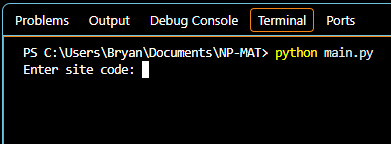
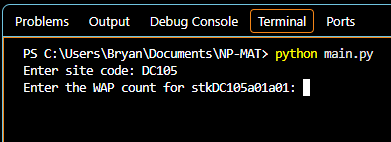
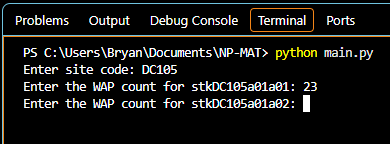
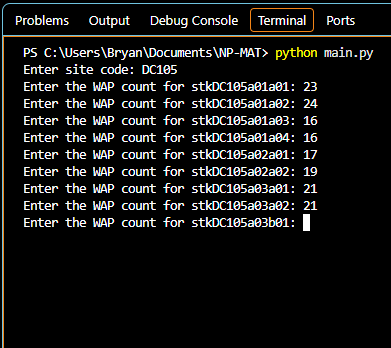
INPUT:
The Network Port-Matrix Automation Tool
collects the required site and switch-stack
information before generating the port matrix.
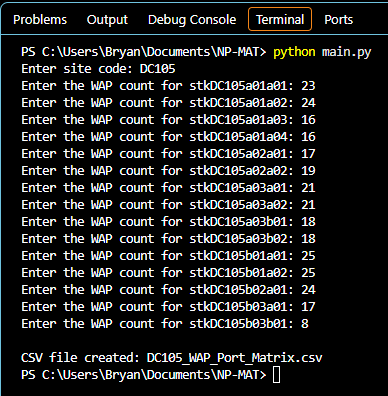
OUTPUT:
The Network Port-Matrix Automation Tool
can display the formatted matrices to the
terminal or can generate a port-matrix CSV file